- Home
- Applications
- Machine Vision
- Eye Tracking
Machine Vision
Eye Tracking
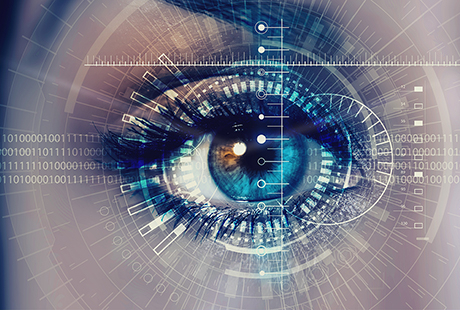
Eye tracking is a technology that measures gaze direction, pupil position, and eye-movement behavior using cameras and image-processing algorithms. It can identify fixation points, blink frequency, gaze trajectories, and attention distribution, and is widely applied in wearable devices, medical diagnostics, human–machine interfaces, assistive communication, behavioral research, and AR/VR systems. As eye tracking relies on fast and precise capture of both the pupil and corneal reflections, image quality, tracking accuracy, and response speed are all critical to overall system performance.
Integrating Global Shutter (GS) image sensors into an eye-tracking system significantly enhances tracking stability and accuracy. By exposing the entire frame at once, GS technology eliminates high-speed distortions—such as skew or warping—allowing pupil position and iris boundaries to be captured with greater precision. As ocular motion can be extremely rapid, PixArt’s high-frame-rate GS sensors effectively reduce motion blur, delivering more reliable pupil tracking and gaze estimation.
PixArt’s miniaturized GS imaging solutions are ideally suited for low-latency, high-precision eye-tracking applications, including VR headsets, medical diagnostic devices, and advanced human–machine interaction (HMI) interfaces. In AR/VR systems where device footprint and power consumption are critical constraints, our compact GS sensors maintain stable, high-accuracy tracking at low power—improving overall system performance and delivering a smoother, more immersive user experience.